EN



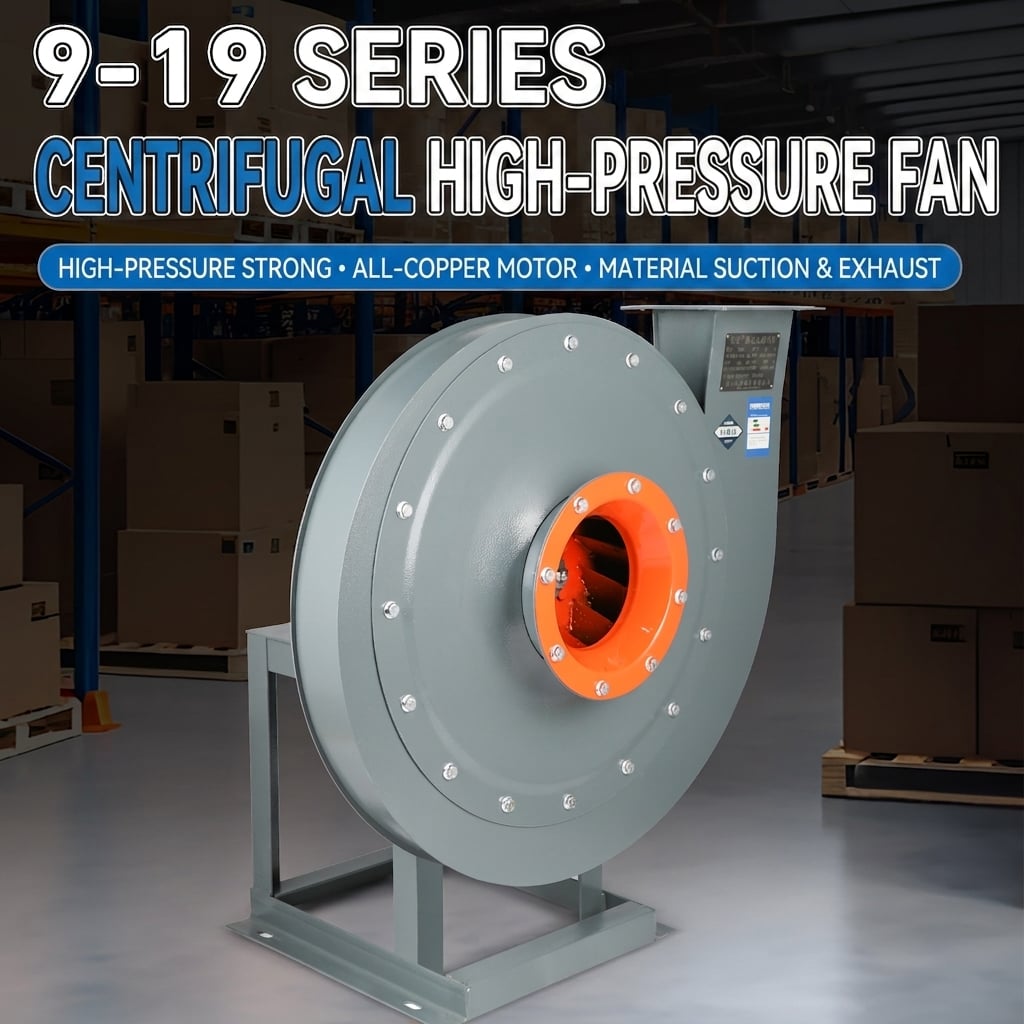
9-19 High-Pressure Centrifugal Fan 9,200 Pa for Forging
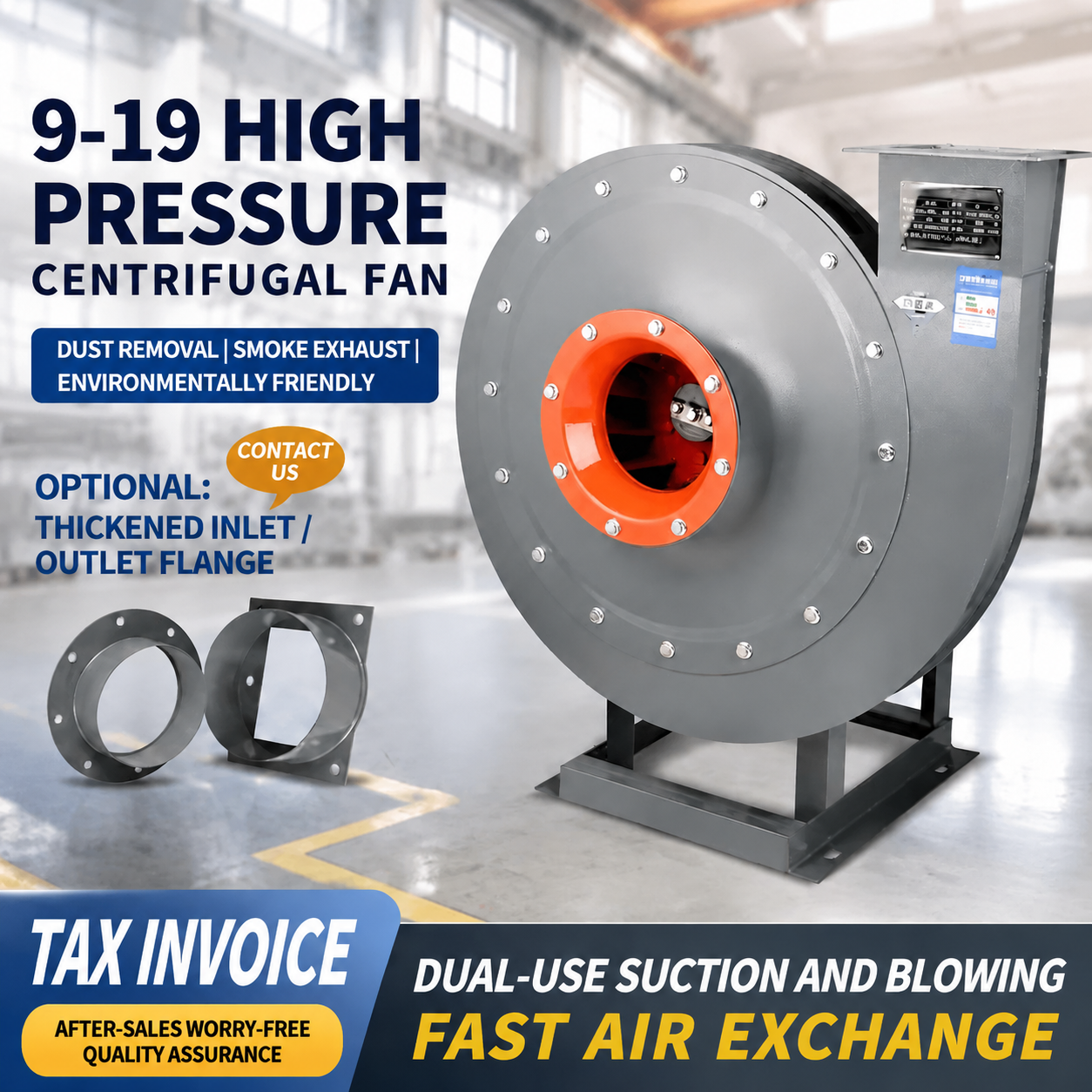
The 9-19 high-pressure centrifugal fans can be widely used for conveying materials, air, and gases that are non corrosive, non self igniting, and do not contain viscous substances. The temperature of the conveyed medium generally does not exceed 80 ° C, and the dust and hard particles contained are not greater than 150 mg/m³. Suitable for high-voltage forced ventilation in industries such as general forging and metallurgy, glass, ceramics, radio, electroplating, and batteries, as well as material transportation in processing industries such as grain, feed, mineral powder, and plastics.
- Overview
- Recommended Products
9-19 High-Pressure Centrifugal Fans: Technical Overview
When an industrial ventilation system must push air against significant ductwork resistance, choosing the right fan type is a critical engineering decision. The 9-19 high-pressure centrifugal fans are designed for applications where pressure head requirements exceed what standard axial alternatives can deliver. If your installation involves extended duct runs, multiple bends, or process back-pressure, the 9-19 series addresses these demands directly.
Product Definition
The 9-19 high-pressure centrifugal fans are engineered for high-static-pressure forced ventilation and material conveying in industrial environments. Unlike axial fans that move air parallel to the shaft, centrifugal fans redirect flow perpendicular to the intake. This geometry allows the impeller to add energy to the air continuously along the blade path, which is why centrifugal designs maintain pressure output even as system resistance increases — a characteristic that axial fans cannot replicate in high-resistance ducted systems. The centrifugal impeller converts motor torque into radial airflow acceleration, developing substantially higher pressure differentials than comparably sized axial units.
The conveyed medium must be non-corrosive, non-self-igniting, and free of viscous substances. Medium temperature must not exceed 80°C, and dust or hard particles must remain at or below 150 mg/m³. These parameters define the operating envelope; specifying these fans outside them requires a different product.
Core Performance Specifications
| Parameter | Value |
|---|---|
| Maximum Airflow | 7,000 m³/h |
| Maximum Total Pressure | 9,200 Pa |
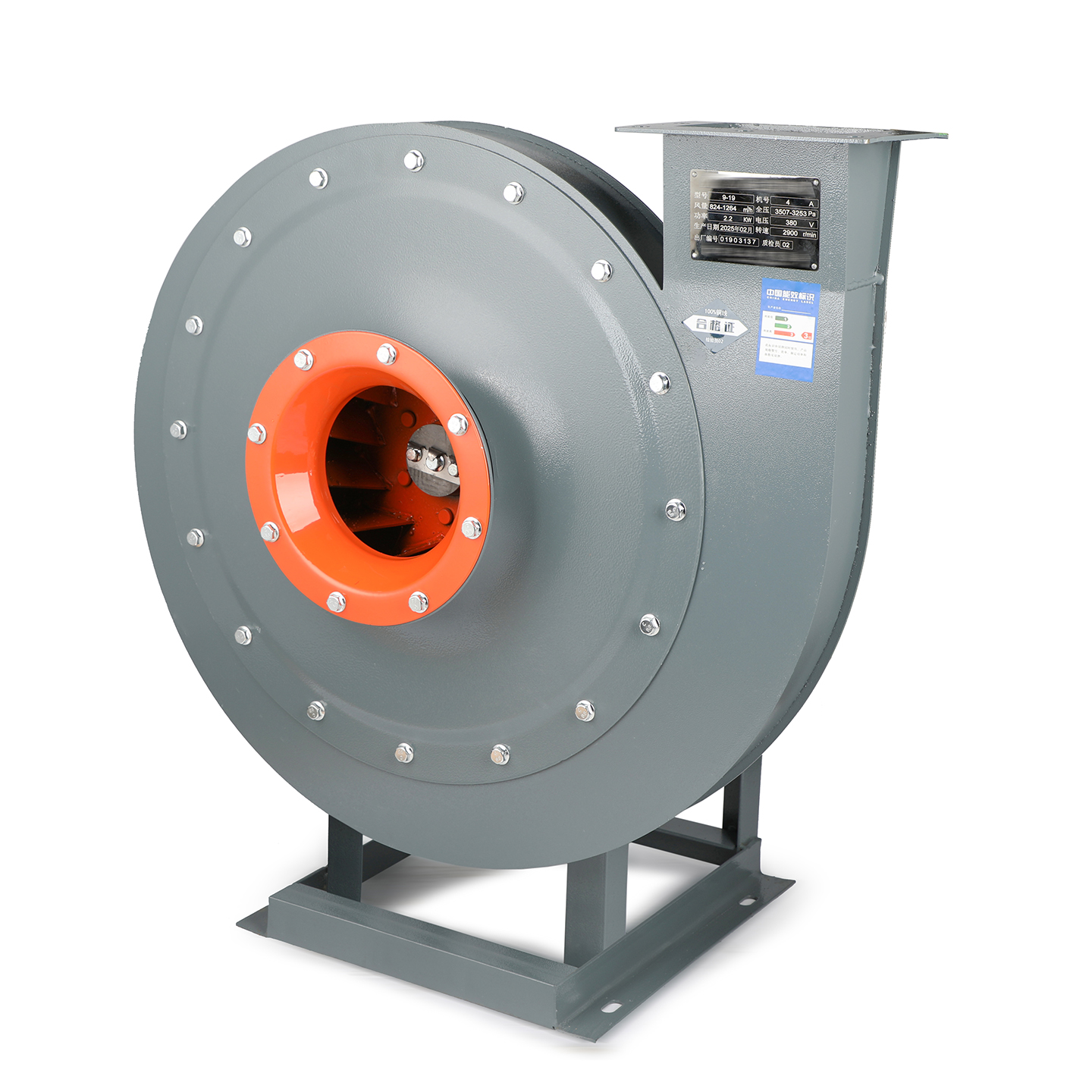
| Typical Airflow (per unit) | 824–1,284 m³/h |
| Typical Pressure (per unit) | 3,253–3,507 Pa |
| Motor Voltage | 380V |
| Motor Power Range | 0.75 kW – 30 kW |
| Medium Temperature Limit | ≤ 80°C |
| Max Particulate Concentration | ≤ 150 mg/m³ |
The 380V motor configuration of the 9-19 high-pressure centrifugal fans connects directly to standard industrial three-phase infrastructure. For facilities already operating at 380V distribution, this eliminates step-down transformer costs that otherwise add up across a multi-unit installation.
Key Features
All-Copper Motor Windings
The motor uses 100% copper windings rather than aluminum alternatives. Aluminum winding substitutes are more common in cost-reduced units because aluminum is lighter and cheaper to process. The trade-off is higher electrical resistance per unit cross-section, which translates to greater energy losses at operating current. For continuous-duty applications running more than 12 hours per day, this difference accumulates and can affect both energy consumption and motor operating temperature. Copper provides better thermal conductivity and lower resistive losses during sustained continuous-duty operation. In practice, most motor thermal failures do not appear in the first weeks — they accumulate over the first full operating season, particularly when ambient temperatures at the installation site were not confirmed during specification. For foundry ventilation zones or poorly ventilated enclosures, verify ambient temperature at the motor before commissioning.
Dual-Use Suction and Blowing
The 9-19 high-pressure centrifugal fans support both negative-pressure suction and positive-pressure blowing modes. This dual-use capability allows the same unit to serve material intake conveying or pressure-side air supply depending on duct system integration, reducing the need to stock two separate fan types for multi-mode facilities.
Thickened Inlet and Outlet Flanges
Inlet and outlet flanges are built with additional wall thickness. In ducted installations subject to vibration or thermal cycling, flange seal integrity is a common long-term failure point. The reinforced flanges reduce seal degradation and mechanical fatigue in the connection zone — relevant in material conveying applications where pipelines impose mechanical stress on the fan connection points.
Wide Power Range
The series spans 0.75 kW through 30 kW across twelve motor steps: 0.75, 1.1, 1.5, 2.2, 3, 3.8, 4, 5.5, 7.5, 15, 18.5, and 30 kW. This broad range allows procurement teams to source multiple size grades from a single product family, simplifying vendor qualification and after-sales logistics across different process zones.
Application Scenarios
Heavy Industry Forced Ventilation
The 9-19 high-pressure centrifugal fans are rated for forced ventilation in forging, metallurgy, glass, ceramics, electroplating, and battery assembly environments. These applications require controlled positive or negative pressure ventilation with thermal load, chemical fumes, or fine particulate within the rated medium parameters. Static pressure up to 9,200 Pa provides the head needed to push air through long duct runs or multi-floor ventilation systems where lower-rated units lose performance as system resistance rises. If ambient temperature stays below 80°C and particulate concentration below 150 mg/m³, these fans are a direct fit for this class of forced-ventilation installations.
Material Conveying: Grain, Feed, Mineral Powder, and Plastics
In pneumatic conveying systems for grain, animal feed, mineral powder, and plastic granules, the 9-19 high-pressure centrifugal fans serve as the pressure source driving material through the conveying pipeline. The application is appropriate where the material is non-corrosive, non-flammable, and dust concentration stays at or below 150 mg/m³. For grain conveying, verifying fine dust concentrations during peak throughput is a step worth completing during system design rather than deferring to post-commissioning.
Dust Removal and Fume Exhaust
These fans can drive workshop dust removal and industrial fume exhaust systems. Filter pressure drop in a dust collector typically starts low and increases as filter media loads with particulate. An axial fan operating at fixed speed will see airflow drop as resistance rises. A centrifugal fan's characteristic curve is better suited to maintaining flow across this variable resistance range, which is why centrifugal designs are preferred for filter-loaded dust extraction systems. In ceramics or glass production environments requiring consistent fume extraction, this pressure-maintaining characteristic provides more stable system performance over the full maintenance interval.
Selection Guidance
The 9-19 high-pressure centrifugal fans are industrial-grade units with documented nameplate quality inspection: factory serial number, QC inspector code, production date, and energy efficiency certification. For overseas buyers, the 380V specification is directly compatible with standard three-phase industrial distribution in most markets, and manufacturing is backed by traceable batch documentation.
The centrifugal design's pressure advantage is most meaningful where duct resistance is high. For short-run exhaust with minimal back-pressure, a lower-pressure axial unit may suffice at lower unit cost. The value of these high-pressure fans is precisely in pressure-demanding industrial and material handling applications — the operating envelope they were built for.