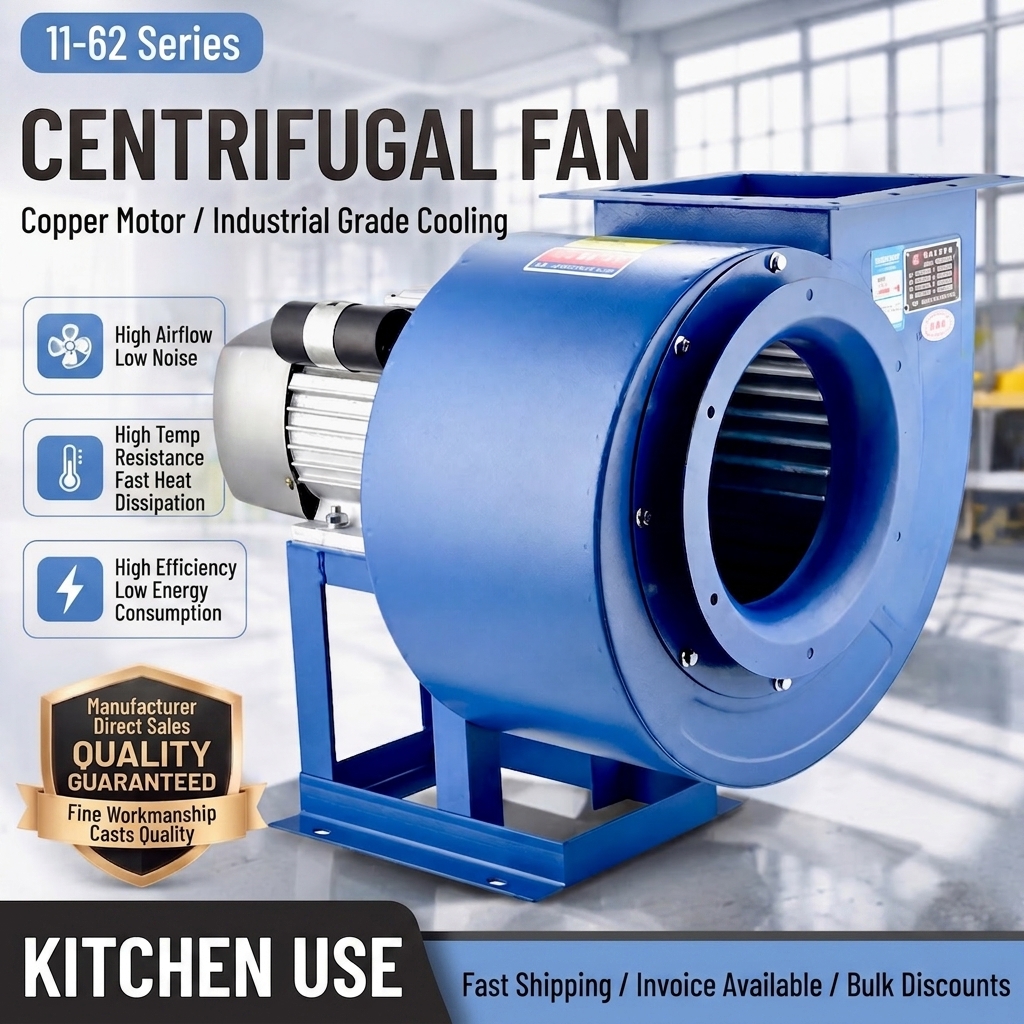
What Are Kitchen Centrifugal Fans?
Kitchen centrifugal fans are purpose-built ventilation units designed to handle the demanding exhaust requirements of commercial kitchens, food service environments, and industrial production facilities. Unlike standard axial units, kitchen centrifugal fans use a rotating impeller to draw air inward and discharge it at a right angle, generating the static pressure needed to push exhaust air through ductwork, grease filters, and exhaust stacks. For procurement managers sourcing ventilation equipment for high-volume cooking environments, this pressure-generating capability is the functional distinction that matters most — and the one most often underestimated in initial system specifications.
This category includes multi-wing centrifugal models and cabinet-style smoke exhaust fans engineered for applications ranging from unit canteens and hotel kitchens to grain machinery, plastic machinery, and food processing production lines. Kitchen centrifugal fans in this range deliver airflow capacities up to 20,000 m³/h and static pressure ratings up to 1,000 Pa, serving installations where both air volume and resistance must be matched against actual duct system conditions — not just headline specifications.
Key Product Characteristics
The kitchen centrifugal fans in this category are distinguished by several engineering characteristics relevant to commercial and industrial buyers:
-
Multi-wing impeller design: The multi-wing blade configuration delivers higher airflow efficiency and lower noise output compared to single-blade commodity alternatives. Strict dynamic balancing of the impeller and drive belt results in smooth, low-vibration operation — a meaningful advantage in installations where fan noise affects kitchen staff, adjacent workspaces, or building occupants on nearby floors.
-
High static pressure performance: These units achieve up to 1,000 Pa of static pressure, enabling effective ventilation in installations with longer duct runs, multiple bends, or integrated grease filters. This specification is the starting point for any duct system resistance calculation. Real-world delivered airflow in a commercial kitchen exhaust system also depends on duct routing, filter loading, and discharge configuration.
-
High-flow capacity: Maximum airflow ratings up to 20,000 m³/h make these kitchen centrifugal fans suitable for single-fan systems serving large canopy hoods or multi-point exhaust networks in hotel and institutional kitchen environments.
-
IP65-rated motor enclosures (cabinet series): The PCF Series uses high-temperature coils and high-temperature ball bearings to address the demanding operating conditions of commercial kitchen exhaust, where elevated temperature and humidity are continuous factors. The IP65 rating indicates protection against dust ingress and water jets — relevant in kitchen environments with steam, condensate, and periodic cleaning activity.
-
Low-noise engineering: Low-noise design is applied across the full range, achieved through impeller geometry optimization, dynamic balancing, and direct-drive motor mounting in the PCF series to eliminate belt-related noise sources. Fan noise is not just a comfort issue — it affects regulatory compliance, worker health, and neighbor relations across virtually all end-market segments.
-
Wide application adaptability: Beyond kitchen exhaust, these centrifugal fans serve grain machinery, chemical machinery, plastic machinery, and food processing production lines, making the category relevant to procurement managers sourcing ventilation for multi-use industrial facilities.
Common Applications for Kitchen Centrifugal Fans
The primary application is commercial kitchen exhaust — removing smoke, cooking vapors, grease-laden air, and odors from restaurants, hotel kitchens, institutional canteens, and food service facilities. Roof-mounted or duct-integrated configurations direct exhaust through canopy hoods and up through building roof penetrations or wall discharge points. Buyers of kitchen centrifugal fans typically prioritize grease and vapor handling capability, airflow volume matched to hood size, noise level, and compatibility with variable speed controls.
Beyond commercial kitchen exhaust, these fans address several adjacent applications that procurement managers encounter in multi-segment facility projects:
-
Smoke extraction in public buildings: The PCF Series is designed for smoke exhaust in public buildings, where ventilation performance during emergency conditions is subject to building code and fire safety requirements. Buyers evaluating kitchen centrifugal fans for smoke control applications should verify that product documentation aligns with the applicable standards for their specific market.
-
Hotel and hospitality facilities: Multi-wing models handle exhaust across restaurant kitchens, banquet preparation areas, and utility ventilation points where consistent airflow performance and low noise are both required during service hours.
-
Food and grain processing lines: The wide adaptability of these centrifugal fans extends to production environments including grain machinery, where airflow and pressure requirements are defined by process parameters rather than occupant comfort criteria.
-
Industrial production ventilation: Chemical machinery and plastic machinery production environments create ventilation loads that require reliable static pressure performance to move air through process-integrated ductwork, particularly where exhaust streams carry particulates or chemical vapors.
How to Choose Kitchen Centrifugal Fans
From a procurement standpoint, the real question with kitchen centrifugal fans isn't just price — it's whether the fan's performance curve matches the actual resistance of the duct system it's going into. In practice, most undersizing problems don't surface immediately after installation. They appear once the system runs under full kitchen load, particularly during peak service hours when cooking intensity and grease filter loading are both at maximum. Here is a working selection framework:
-
Airflow requirement (m³/h): Establish the required airflow based on kitchen volume, cooking intensity, and hood size. The installed airflow will be lower than the rated free-delivery figure due to duct resistance. A system calculation that accounts for duct length, bends, filters, and discharge conditions is the only reliable basis for selection.
-
Static pressure requirement (Pa): Calculate the total static pressure the fan must overcome in the installed system. For systems with grease filters, extended ductwork, or roof exhaust stacks, this figure can approach or exceed 600–800 Pa. Models rated at 1,000 Pa provide operating margin for most commercial kitchen installations.
-
Ambient temperature: Commercial kitchen ceiling spaces above canopy hoods can reach temperatures significantly above standard ambient conditions during peak service. Verify that the motor's thermal specification is appropriate for the actual installation ambient, not just the catalog standard condition — overlooking this is one of the more common causes of premature motor failure in kitchen exhaust applications.
-
Noise level and compliance requirements: Yes, low-noise multi-wing design is a genuine advantage in kitchen centrifugal fans. That said, if noise propagation to adjacent spaces is a specific compliance concern, you'll need to evaluate the noise vs. airflow trade-off explicitly. A larger unit running at lower RPM typically produces less noise at a given airflow than a smaller fan at maximum speed, but mounting position, duct configuration, and structural transmission all affect the final installed noise level.
-
IP rating for the environment: For installations with high humidity, steam, or periodic washdown exposure, an IP65-rated motor enclosure provides meaningful protection. Confirm the IP requirements for your specific installation zone before selecting between standard and cabinet-style models.
-
Cabinet vs. inline configuration: The PCF Series uses a direct-drive cabinet configuration that simplifies maintenance access and eliminates belt-drive noise contributions. Inline duct configurations suit installations where cabinet mounting is not practical due to space constraints or ductwork routing.
Why Low-Noise Multi-Wing Design Matters
Fan noise in commercial kitchen environments affects more than operator comfort. In urban food service operations and food processing facilities located near offices or residential areas, noise from kitchen centrifugal fans can trigger building compliance reviews or workplace noise complaints. Industrial noise regulations in major target markets set thresholds that vary by application type and time period, and consequences of exceeding them range from operational restrictions to project approval delays.
The multi-wing impeller design applied in these kitchen centrifugal fans achieves aerodynamic optimization across noise, efficiency, and pressure performance simultaneously. Dynamic balancing of the impeller and belt reduces vibration transmission to the building structure. For procurement managers sourcing fans for noise-sensitive environments — food processing lines adjacent to offices, hotel kitchens in occupied buildings, or institutional canteens near workspaces — this engineering approach addresses a compliance requirement, not just a comfort preference.
The centrifugal fan segment serves both commercial HVAC and process ventilation applications across a wide range of industries. The combination of a multi-wing centrifugal series and a cabinet-style smoke exhaust series within one product range supports procurement simplification for projects that include both kitchen exhaust and smoke control requirements. Pre-sale technical consultation is available for project-specific airflow and pressure sizing questions.
 ×

 EN