×
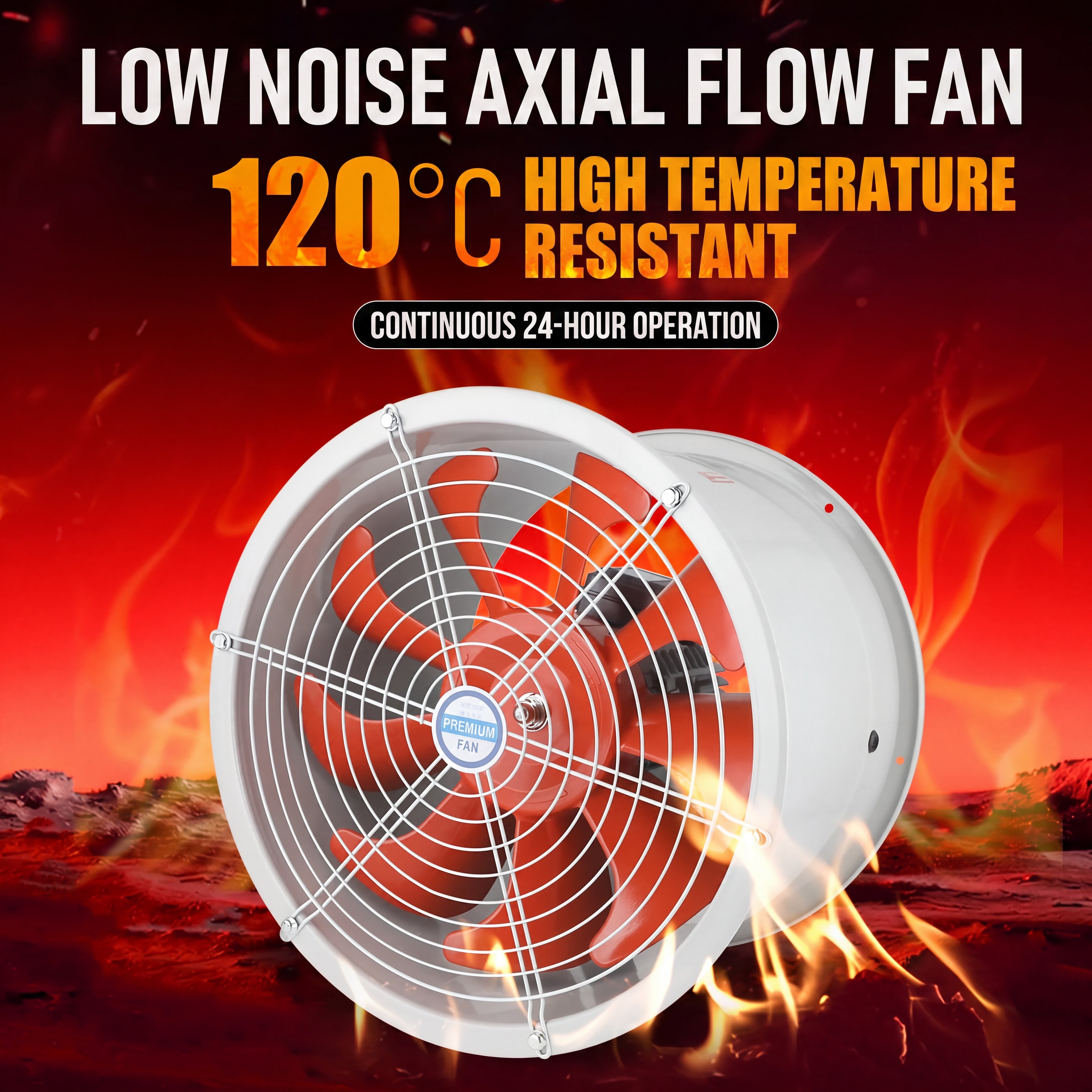
Axial fans move air parallel to the fan shaft, producing high-volume airflow at relatively low static pressure. Because of this design, axial fans are well suited to open-area or lightly ducted ventilation where the priority is throughput rather than pressure-building. The blade angle — whether straight, curved, or sickle-shaped — determines how efficiently the fan converts motor power into airflow, which is why blade geometry varies across different models in this range.
In procurement terms, axial fans in this category cover equipment ranging from portable handheld units for confined-space access to fixed-installation, high-capacity models rated for continuous-duty industrial and agricultural environments. Understanding which sub-type fits your operating conditions before comparing specifications will save time during shortlisting.
This listing includes three models designed for distinct application requirements:
Axial fans in this range serve several overlapping industry segments. From a procurement standpoint, matching the equipment to the operating environment is more important than optimizing for the lowest unit price:
The selection of axial fans requires matching the model to the actual conditions of your installation, not just the rated specification. A few dimensions worth working through before finalizing a procurement decision:
Ambient temperature: One of the more common oversights when selecting fans for high-temperature environments is choosing a model for the standard 40°C ambient rating without checking actual ceiling or enclosure temperatures during peak operating periods. In summer-loaded greenhouse bays or above-furnace industrial positions, real ambient temperatures can significantly exceed standard assumptions, resulting in premature motor insulation breakdown. If your installation has a temperature factor, verify the motor insulation class — Class F or H — before committing.
Material and corrosion resistance: Standard carbon steel axial fans will corrode in food processing washdown environments, chemical atmospheres, and humid agricultural settings. Yes, stainless steel axial fans command a cost premium — that is a real procurement constraint. But in environments where corrosion-driven early replacement is the failure mode, the material upgrade often justifies itself over a 3-to-5-year operational horizon. Whether the premium is warranted depends on the actual corrosion exposure level of your specific installation.
Fixed installation versus portability: For permanent ventilation requirements, fixed-mount models with the appropriate airflow and temperature ratings will outperform portable units on energy efficiency and noise over sustained operation. For temporary access or maintenance scenarios, portability and fast deployment matter more than optimized continuous-duty performance.
Fan sizing: Counterintuitively, oversizing axial fans for a small drying room or greenhouse bay can create more problems than undersizing — including excessive noise and unnecessary energy consumption at partial load. In most agricultural installations, airflow shortfalls do not surface immediately; they become visible after the system runs through a full seasonal cycle and cumulative performance gaps appear. Sizing should be based on the peak load case, not the average operating condition.
Single unit versus distributed layout: For larger spaces, the decision between one high-capacity unit and several smaller distributed axial fans involves real trade-offs. A single large unit simplifies procurement and maintenance scheduling but creates a single point of failure for the entire ventilation zone. Distributed smaller axial fans add wiring complexity but improve redundancy and more evenly distribute airflow across long or multi-span agricultural buildings.
The industrial axial fans segment is price-competitive at the commodity level, with standard-specification models available from multiple suppliers. For buyers sourcing primarily on price, the differentiation that matters — motor insulation class, blade material, corrosion protection, and ambient temperature rating — often only becomes visible after installation. Facilities running continuous-duty equipment in agricultural or industrial settings where fans operate 12 to 24 hours per day have found that incorrect specification results in energy costs above budget and replacement cycles shorter than planned.
This range of axial fans covers three distinct configurations suited to different operating requirements: portable confined-space units, stainless steel high-temperature models, and aluminum blade continuous-duty fans. Each has a different target application, and selecting the wrong configuration for a given environment is a procurement error that specification reviews are designed to prevent. For buyers in markets such as the US, Germany, Australia, India, or Turkey, confirming that the selected axial fans match your local electrical supply — voltage and frequency — and operating environment conditions is a recommended step before order placement.
We are a professional manufacturer integrating design, development, and production, specializing in axial fans, centrifugal fans, kitchen exhaust fans and vortex blowers
District 8, Zhaoyang Village, Daxi Town, Wenling City, Taizhou City, Zhejiang Province
Copyright © 2026 by Taizhou Zicheng Electromechanical Co., Ltd. Privacy Policy

 EN