×
Industrial centrifugal fans — also called centrifugal blowers — redirect incoming airflow by 90 degrees through a rotating impeller, generating the static pressure required to push air through ducted systems, filters, and process equipment. Unlike axial fans, which move air along a shaft axis, industrial centrifugal fans build pressure as airflow accelerates through the impeller housing, making them the preferred choice wherever a ventilation system must overcome significant resistance from ductwork, bends, or inline process equipment.
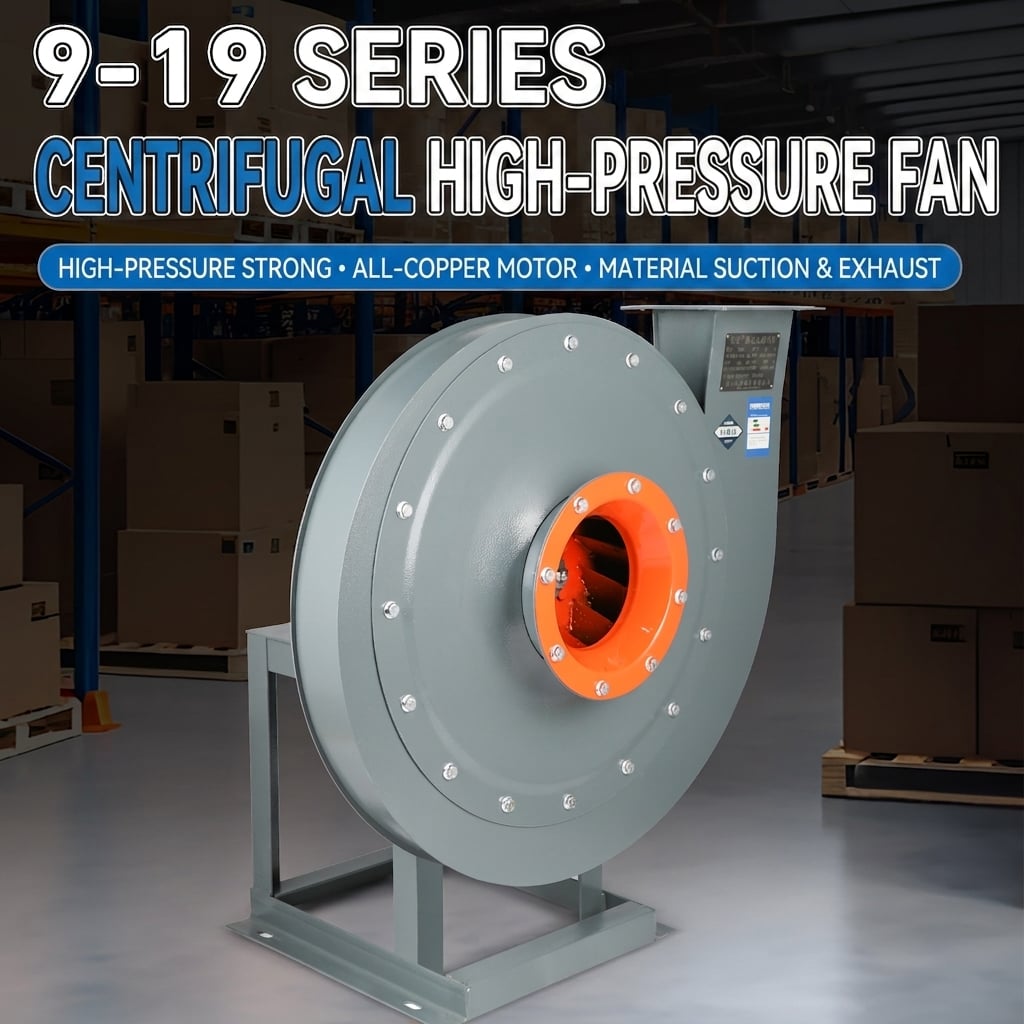
This category includes four industrial centrifugal fans organized across two series: the 9-19 and 9-26 high-pressure models, designed for demanding industrial process ventilation, and the 4-72A universal models — available in standard steel and 304 stainless steel — suited for broader HVAC and industrial air exchange applications. Whether you are specifying a replacement for a grain conveying system or sourcing industrial centrifugal fans for a new metallurgical facility, understanding where each model fits is the starting point for a sound procurement decision.
Industrial centrifugal fans in this category cover two distinct performance segments. The high-pressure 9-19 and 9-26 series are engineered for process ventilation circuits with elevated static pressure requirements, while the 4-72A series addresses the higher-volume, lower-pressure end of the market.
Industrial centrifugal fans serve a broad range of process and HVAC ventilation contexts. The 9-19 and 9-26 high-pressure series are well established in applications where static pressure requirements exceed what axial configurations can reliably deliver:
The 4-72A series of industrial centrifugal fans addresses lower-pressure, higher-volume ventilation requirements:
Selecting industrial centrifugal fans for ducted process ventilation is genuinely application-specific. The same rated airflow capacity performs very differently in a clean, straight duct versus a system with multiple bends, long horizontal runs, and inline filters. If your priority is matching fan output to actual installed performance, completing a system resistance calculation before committing to a model is worth the time investment.
A point that recurs in industrial centrifugal fan procurement: oversizing a fan for a small or medium ducted system typically causes more operational problems than undersizing. Counterintuitively, industrial centrifugal fans running well above the system operating point will operate in an unstable region of the performance curve, producing pressure surging, elevated noise, and unnecessary energy consumption at partial load. The correct approach is to match the selected model to the actual system resistance curve, not to a conservative worst-case maximum.
For high-pressure applications in forging, metallurgy, or material conveying, the 9-19 and 9-26 series of industrial centrifugal fans cover the performance requirements of most process ventilation circuits in this segment. The choice between the two models should be resolved by overlaying the actual system resistance curve against each fan's published performance data. For both models, operating environments must stay within the 80°C temperature limit for conveyed media and the 150 mg/m³ particulate content constraint. One installation failure that appears repeatedly in foundry and furnace ventilation projects is specifying industrial centrifugal fans against standard ambient conditions without verifying actual ceiling-level temperatures during peak operating hours. If the installation environment may exceed standard ambient — as is common in high-bay metallurgical and forging facilities — the motor thermal rating deserves careful review against the actual ambient condition before selection is finalized.
For lower-pressure air exchange applications, the 4-72A series of industrial centrifugal fans offers a wider airflow range and four structural configurations that adapt to different mounting orientations and duct connection arrangements. If the application involves corrosive media, persistent humidity, chemical vapors, or food processing-adjacent air handling, the 304 stainless steel variant is the appropriate material specification. Yes, it carries a higher unit cost and may involve longer fabrication lead times compared to the standard model — that is a real procurement constraint. But if the installation environment would degrade mild steel construction over the equipment service life, the material upgrade typically recovers its cost differential within the first maintenance cycle.
For all industrial centrifugal fans in this category, installations involving ductwork with bends, filters, and equipment resistance that was not fully modeled during specification should build in a pressure safety margin when selecting between models. Delivered airflow in a real installation rarely matches the clean-air rated figure on the datasheet, and the performance gap increases with every fitting added to the duct circuit.
For industrial procurement teams evaluating industrial centrifugal fans across multiple applications — from high-pressure process ventilation to general facility air exchange — the category spans a performance range wide enough to cover most ducted ventilation requirements in manufacturing, mining, agricultural, and chemical processing environments. The high-pressure 9-19 and 9-26 series address process-critical applications where static pressure determines system adequacy; the 4-72A series of industrial centrifugal fans covers the broader facility ventilation market with a flexible power and mounting configuration range.
The centrifugal operating principle — generating static pressure through impeller rotation rather than axial thrust — makes industrial centrifugal fans the standard choice for ducted systems that must push air through resistance: filters, long duct runs, process equipment connections, and control dampers. For buyers in mining, petrochemical, metallurgical, and agricultural sectors evaluating industrial centrifugal fans for applications where duct system resistance is a material design variable, the performance envelope of these models covers the range from moderate general ventilation to high-pressure forced-air process circuits.
For international procurement teams sourcing these industrial centrifugal fans, all motors in this category operate on 380V / 50Hz, which aligns with EU, Australian, Indian, and Turkish electrical infrastructure standards. For buyers in the United States operating on 60Hz distribution systems, voltage and frequency compatibility should be confirmed with the supplier before order placement. Technical specification documentation is available to support engineering integration planning and procurement review processes across all target markets.
We are a professional manufacturer integrating design, development, and production, specializing in axial fans, centrifugal fans, kitchen exhaust fans and vortex blowers
District 8, Zhaoyang Village, Daxi Town, Wenling City, Taizhou City, Zhejiang Province
Copyright © 2026 by Taizhou Zicheng Electromechanical Co., Ltd. Privacy Policy

 EN