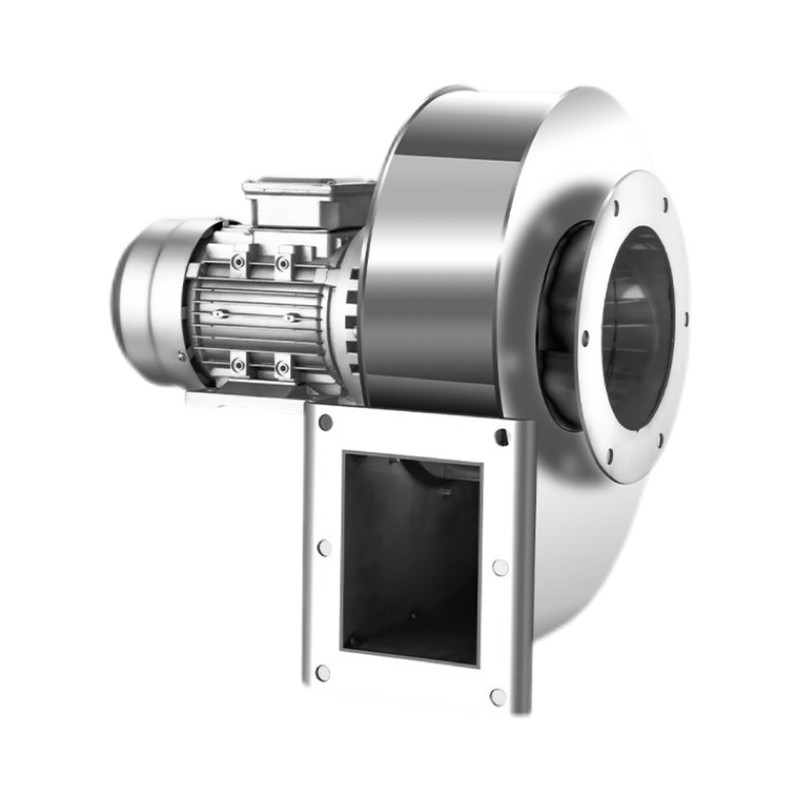
Start With the Duty Point
Industrial air fans work best when the duty point is clear. A duty point has two main parts: the airflow you need and the pressure the fan must overcome. Start with the air volume needed at the hood, machine, room, or discharge point. Then list the loss caused by duct length, bends, filters, dampers, and outlets. This is the simple first step for choosing industrial air fans.
Do not choose industrial air fans from an open-air airflow number alone. Industrial air fans may move a large volume of air with no duct connected. The same industrial air fans can move less air when the duct has bends or a dirty filter. The system curve and the fan curve should meet at the needed duty point. This check helps avoid industrial air fans that are too small or industrial air fans that run far from their best point.
Choose the Right Pressure Class
The listed industrial air fans include high-pressure and general centrifugal choices. The 9-19 high-pressure centrifugal fan is listed with up to 9,200 Pa and power from 0.75 kW to 30 kW. Its record states use for forced ventilation and conveying of non-corrosive, non-self-igniting, non-viscous media within the stated limits. The 9-26 high-pressure centrifugal fan is another of the listed industrial air fans and also lists up to 9,200 Pa for forced ventilation and conveying.
- Use high-pressure industrial air fans only after airflow, pressure, medium, and temperature have been checked against product data.
- Review the carbon steel 4-72A for general factory air exchange when the system is within its listed 2,500 Pa maximum pressure and 20,000 m³/h maximum airflow.
- Review the 304 stainless 4-72A where its listed housing material suits the site, while checking the full air-stream conditions.
These industrial air fans are not the same product in different sizes. A short route with low loss can need different industrial air fans from a long route with filters and process loss. Industrial air fans should follow the real job.
Check the Air Stream
Industrial air fans must also match the air stream. The product records for the selected models state limits for gas temperature and particles. The listed 9-19 and 9-26 series show a maximum medium temperature of 80°C and dust or hard particles at or below 150 mg/m³. The selected 4-72A industrial air fans also state an 80°C maximum gas temperature and a 150 mg/m³ particle limit.
Check these values at the industrial air fans' inlet during the hardest part of the process. Room air can be cooler than the air entering industrial air fans. A normal day can also have less dust than a peak shift. For carbon steel industrial air fans, confirm that the gas fits the listed product boundary. The stainless 4-72A uses a 304 stainless steel housing, but the buyer still needs to tell the supplier about moisture, chemicals, heat, and particles.
Do not assume that these industrial air fans fit a flammable, explosive, corrosive, or viscous air stream. If the air stream is outside the published limits, ask for a separate technical review. This gives the supplier a chance to check the risk before industrial air fans are proposed.
Plan Motor and Site Details
Motor power for industrial air fans should follow the duty point. Industrial air fans that are too large can use more power and may make more noise. Industrial air fans that are too small may lose flow when a filter loads or the duct plan changes. The 9-19 record lists a 380 V motor and power options from 0.75 kW to 30 kW. Confirm voltage, frequency, phase, and control needs before placing an order for industrial air fans.
Site details also matter for industrial air fans. Tell the supplier about the mounting position, inlet and outlet direction, open space around the industrial air fans, and connection size. Leave room for service and inspection of industrial air fans. Do not force ductwork into the industrial air fans' casing. Use suitable supports and vibration control where the building or work area calls for it. These points can affect how industrial air fans fit into the final system.
Send a Useful Inquiry
A complete request for industrial air fans should include airflow, static pressure, medium, peak inlet temperature, dust level, duct layout, mounting plan, and electrical supply. Add photos and the old fan label for a replacement project. With these facts, the supplier can compare the duty point with the listed 9-19, 9-26, and 4-72A industrial air fans. The result is a fact-based starting point, not an unsupported promise.

 EN