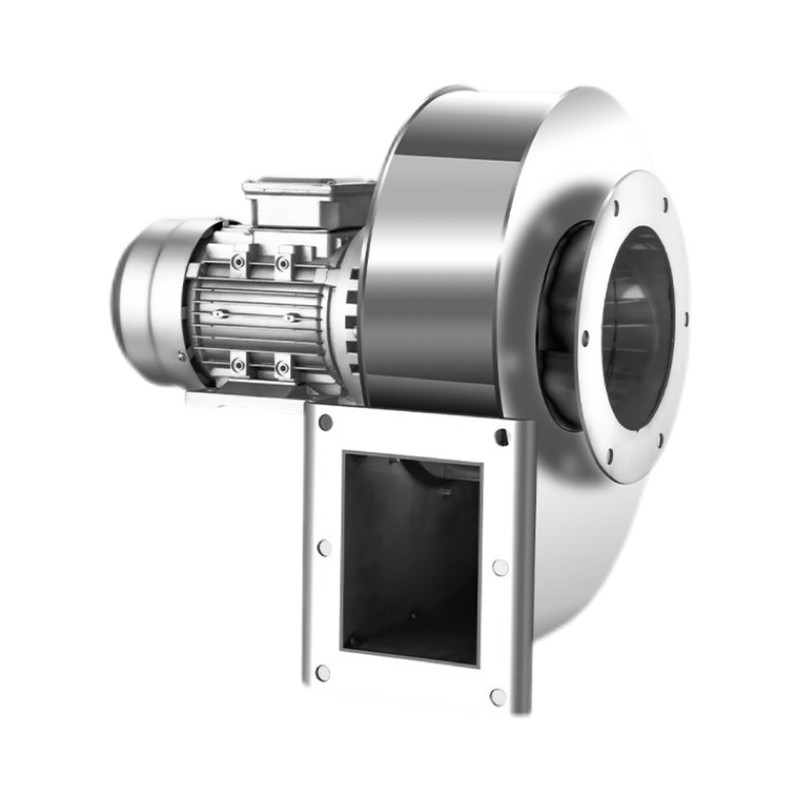
Set the Duty Point First
A heavy duty industrial air blower needs a clear duty point. List the airflow and static pressure. State the inlet temperature. Describe the air or gas. Say if the job is supply air, exhaust, dust control, or conveying. This lets the supplier compare the job with a fan curve.
A heavy duty industrial air blower works with the whole duct system. Ducts, elbows, filters, hoods, and transitions all create loss. A heavy duty industrial air blower can show high flow at its outlet but give less flow after it is fitted to a high-loss system. Share the layout and the parts in the air path before you choose motor power.
Choose the Pressure Class
A heavy duty industrial air blower may need a high-pressure centrifugal fan when the duct system has large losses. The 9-19 product is listed with up to 9,200 Pa and a 0.75 kW to 30 kW motor range. Its record describes forced ventilation and conveying of non-corrosive, non-self-igniting, non-viscous media. It lists an 80°C medium limit. It also lists a dust and hard-particle limit of 150 mg/m³.
A heavy duty industrial air blower may also use the listed 9-26 high-pressure centrifugal fan. That model is listed for high-pressure conveying work and includes a 30 kW version. Use the required flow and pressure together. A top pressure value does not mean the same pressure is available at every flow point.
A heavy duty industrial air blower for general factory ventilation may fit a 4-72A centrifugal fan. The carbon-steel and 304 stainless 4-72A products are listed with up to 2,500 Pa. Check the stated medium and temperature limits for the exact product. Do not use a high-pressure name as proof of fit for every job.
Check the Air Stream
A heavy duty industrial air blower must suit the air stream. The carbon-steel 4-72A record limits use to air or gases that are non-self-igniting, non-corrosive to steel, and non-viscous. It lists an 80°C gas limit. It lists a 150 mg/m³ limit for dust and hard particles. Give the real conditions for review if they differ from these limits.
- A heavy duty industrial air blower needs an inlet temperature measured at the highest expected load.
- A heavy duty industrial air blower needs a clear description of air, gas, dust, and moisture.
- A heavy duty industrial air blower needs a list of filters, hoods, valves, and duct parts that add loss.
- A heavy duty industrial air blower needs confirmed mounting space, duct direction, and site power.
A heavy duty industrial air blower with a stainless housing is a material choice, not an answer to every chemical exposure. The listed stainless 4-72A uses a 304 stainless-steel housing and lists 380 V supply. Provide gas details and chemical exposure. Then the housing choice can be checked for the site.
Plan the Installation
A heavy duty industrial air blower must fit the site. The 4-72A records describe A, B, C, and D structural variants. Check inlet and outlet direction, service access, support space, and duct connections. A heavy duty industrial air blower with a similar name may not fit an old duct route.
A heavy duty industrial air blower also needs the right electrical details. The chosen product records contain 380 V references. State the local voltage, frequency, motor range, and control method. This keeps a catalog title from being treated as a full technical specification.
Send a Useful RFQ
A heavy duty industrial air blower request should state airflow, static pressure, medium, temperature, dust level, voltage, and application. Add a duct sketch if possible. Include the work schedule, housing choice, and space limits. A heavy duty industrial air blower can then be checked against the relevant product range before a model is suggested.

 EN