Define the Exhaust Fan for Industrial Use Duty
Start with the job. An exhaust fan for industrial use may remove room air, pull air through a hood, or support a ducted process. These jobs do not have the same load. Write down the airflow needed at the point of use. Then record the static pressure that the duct system creates. This is the basic data for an exhaust fan for industrial use.
Do not select an exhaust fan for industrial use from motor power alone. Motor power does not describe the full system duty. A fan must move the required air against the actual resistance. Ask for a fan curve when the project needs a technical check. Compare the curve with the system duty point. Use the same check for each exhaust fan for industrial use under review.
Check the Duct Resistance
Duct resistance comes from straight runs, elbows, hoods, filters, dampers, and outlets. Each part can change the duty point. A long run with several bends needs more pressure than a short open discharge. An exhaust fan for industrial use may look suitable at an open inlet but give less air after it is connected to a full duct system.
- List the duct size, length, bends, and branch lines.
- State if the system has filters, a hood, or process equipment.
- Include the discharge route and any future changes to the duct.
Use this list when you discuss an exhaust fan for industrial use. It helps avoid a choice based on a single peak number. It also helps show if a higher-pressure series is needed. The list gives a clearer basis for the exhaust fan for industrial use decision.
Compare the Available Fan Series
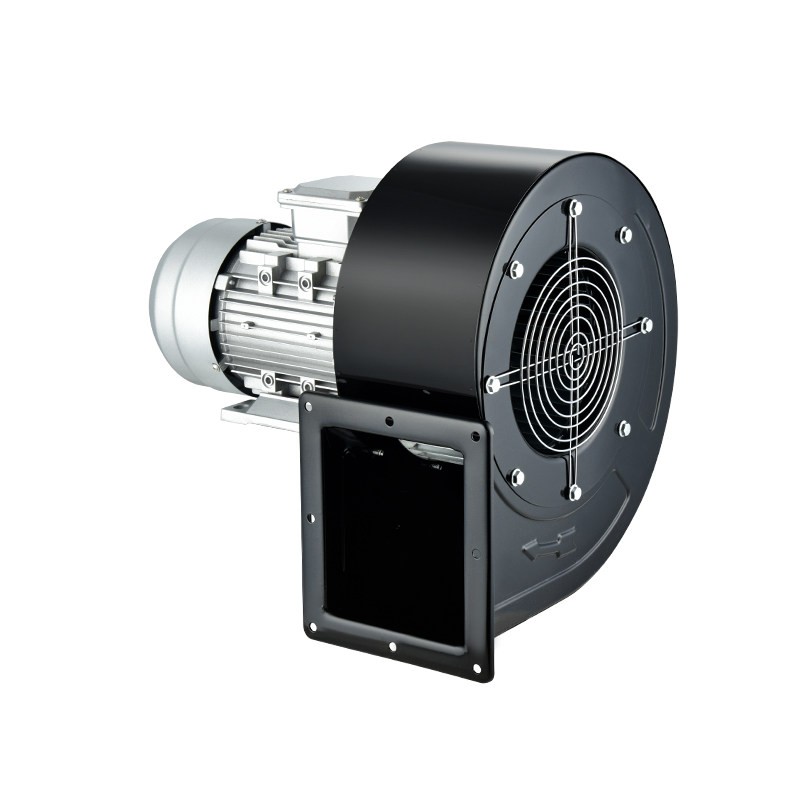
The catalog has several centrifugal options. The 9-19 high-pressure centrifugal fan is listed with up to 9,200 Pa. The 9-26 high-pressure centrifugal fan is also listed for high-pressure duty and conveying. These options may suit a system with high resistance. The 4-72A carbon-steel and stainless models are listed with up to 2,500 Pa. They may be a starting point for general ventilation or a moderate-pressure duct system.
Do not assume that a high-pressure model is right for every exhaust fan for industrial use. A very high pressure rating is not a substitute for a correct duty point. Check the flow, pressure, medium, and installation plan together. Use the stated product limits during the review. This keeps the exhaust fan for industrial use within its intended duty.
Review the Air Stream and Material
The air stream affects an exhaust fan for industrial use. The product records for the 9-19 and 9-26 models state limits for non-corrosive, non-self-igniting media without viscous material. Their records also state a maximum medium temperature of 80°C and a particle limit. The carbon-steel 4-72A record gives a similar operating boundary.
The catalog also includes a 304 stainless 4-72A centrifugal fan. It may be useful to review when the project needs a different housing material. It is not a blanket answer for every process stream. Check the gas, temperature, dust, and local safety needs before you choose an exhaust fan for industrial use. The final exhaust fan for industrial use must match the confirmed medium.
Confirm the Site Interface
Check the inlet and outlet direction, duct connection, mounting space, and service access. Check the voltage and the control plan too. Some selected product records list 380 V. Confirm the site power before you order an exhaust fan for industrial use. A replacement job also needs the old model number, duct layout, and reason for replacement.
For a new project, send a simple duct sketch. Add photos when they help. State the airflow, static pressure, medium, temperature, dust condition, material preference, voltage, and quantity. This gives a supplier a clear base to discuss an exhaust fan for industrial use. It also gives the project team a record for the exhaust fan for industrial use review. Zicheng states that its team can support airflow and static-pressure sizing, model selection, and material and voltage advice before an order.

 EN